 FairTea2030
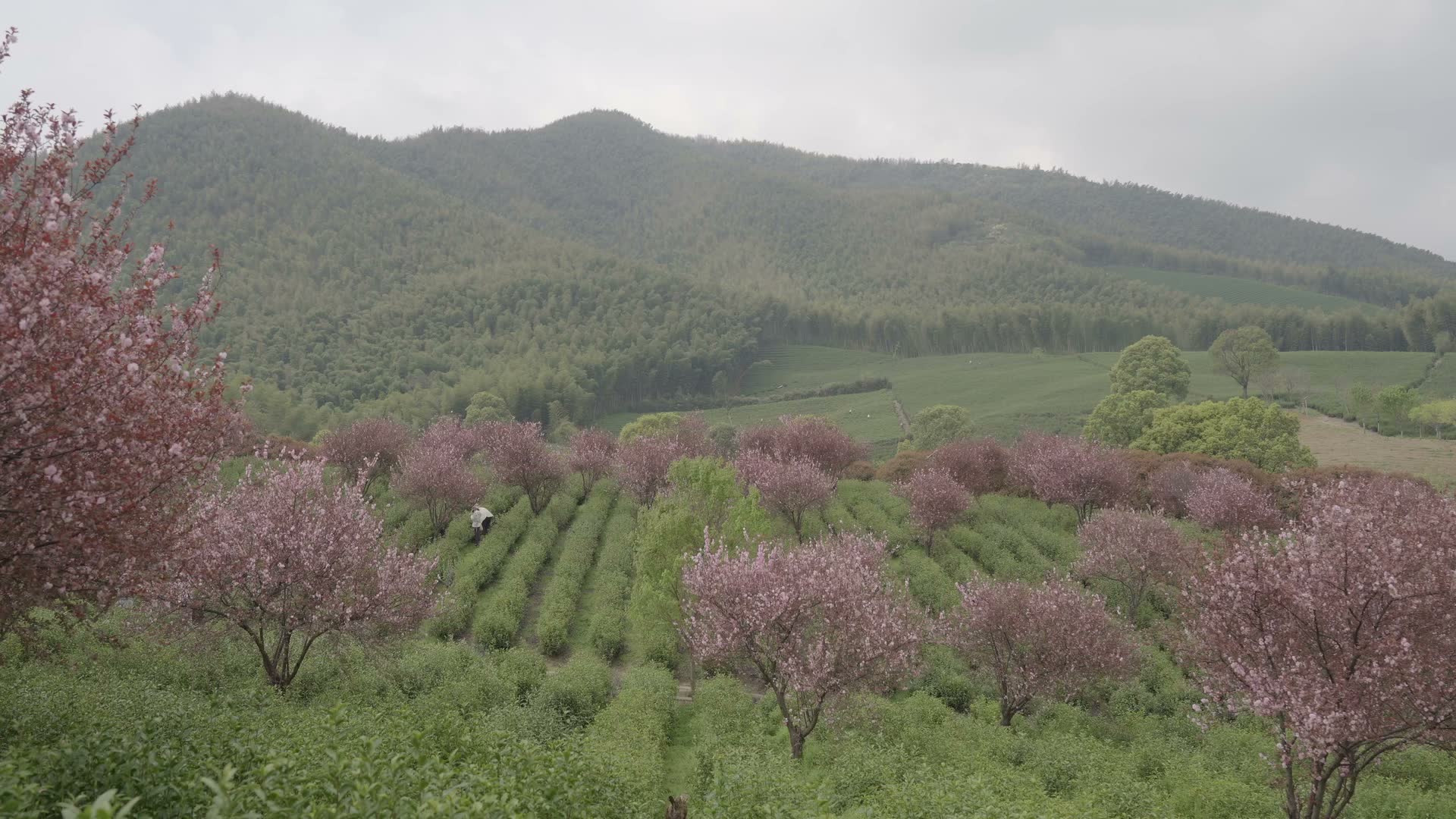
Mothers Chasing the Harvest Season追赶农时的母亲们
Seasonal women tea pickers in China: working conditions, the protection gap, and a five-point policy agenda. Second edition, October 2026. By Molly Yuan.中国的季节性采茶女工:劳动状况、保障缺口与五点政策议程。第二版,2026年10月。作者:Molly Yuan。
Executive summary
China's spring tea is picked by hand, to a standard no machine can meet, by a workforce that is mostly female, mostly over fifty, mostly migrant, and almost entirely uninsured. This paper describes that workforce, sets out the gap between the protection Chinese law offers and the protection these women actually receive, compares how other countries treat comparable seasonal and ageing workers, and proposes five measures that county governments, cooperatives and tea companies can adopt within one harvest cycle.
What the evidence shows. A Ministry of Agriculture survey counted about 33 million tea pickers in China.3 In Zhejiang, which needed 1.58 million pickers in 2022, fewer than 3 percent of pickers are under 35 and 80 percent come from other provinces; one West Lake cohort averaged 58 years old, and Nanjing's pickers average about 55.5 6 11 Migrant pickers in Zhejiang earned 180 to 200 yuan a day in 2025 for shifts of twelve hours or more, which a peer-reviewed study computes at 12.5 to 16.5 yuan an hour, below the provincial minimum wage; the season is 15 to 40 days, and in 2025 a drought and a heat spike cut some pickers' earnings from over 5,000 yuan to about 2,000.7 14 Pickers hired by farming households fall outside the regulations that provide employment injury insurance, and a Henan court has said so in terms; in Xinyang a 2025 scheme insured about 70,000 pickers in a city that estimates it needs 1.5 million at peak.36 41 24 9 The resident pension pays roughly a tenth of a rural living; resident medical insurance paid 66 percent of in-list hospital costs in 2025.26 27
What the fieldwork adds. Over one harvest in Yixing, Jiangsu, the author filmed and interviewed pickers, a labor broker and a garden owner. The film records how leaf is graded and paid for, how pay tickets are kept, who brings the pickers in, where they sleep, and what the women say about the work when the camera is still running.1 Those observations are reported in Section 3 and used throughout.
What we propose. (1) Seasonal employment insurance bought per registered picker for the harvest window; (2) collective contracts through women's picker associations, with day rates and payment dates posted at the collection point; (3) mobile clinics and check-up stations in tea districts during the harvest; (4) an annual labor scorecard published by retailers and brands; (5) recognition of seasonal women tea workers in labor statistics and in cultural heritage programs, with their representatives at the table when harvest-season policy is written.
1Introduction: the overlooked laborers
Across China's countryside lives a largely invisible cohort of women aged roughly 55 to 70. They rarely appear in labor statistics and are seldom covered by social protection, yet each year they shoulder the heaviest seasonal tasks of the farm calendar: tea and mulberry in spring, fruit thinning and weeding in summer, rice in autumn, seedlings and sorting in winter.
This paper is about the spring task, tea picking, because it is the most visible, the most skilled and the best paid of the four, and because it is the one where the gap between the value of the work and the protection of the worker is easiest to see. Premium Chinese green tea is picked to a standard that machines cannot meet: one bud and one leaf, pinched off whole, tens of thousands of times a day, in a window of a few weeks when the leaf is at its best. The people who do this work are, overwhelmingly, older rural women. They travel to the tea hills from inland provinces, sleep in sheds and tents beside the gardens, are paid by the jin at a weigh-in, and go home when the season ends with the money they have earned and nothing else.
Their situation is not an accident of one industry. It is the product of three larger movements in rural China: the departure of younger people and of men for city work, which has left agriculture to older women; the persistence of an urban-rural divide in social insurance; and the growth of a short-term, informal, piece-rate labor market in high-value crops. Tea picking sits at the intersection of all three. What happens to women tea pickers therefore says something about what happens to several tens of millions of rural women who follow the harvest from crop to crop.
The paper proceeds as follows. Section 2 describes the field site and method. Section 3 reports what one harvest in Yixing looks like from the ground, as recorded in the author's documentary. Section 4 assembles the published evidence on who picks China's tea, what they are paid and what the work does to them. Section 5 sets out the structure of Chinese social protection as it applies to older, rural, female, seasonal workers, and shows where it stops short. Section 6 compares the treatment of comparable workers in Korea, Japan, Europe and the certified-tea system. Section 7 presents five recommendations. Section 8 concludes.
2Field site and method
The field material in this paper comes from one spring harvest in Yixing (宜兴), a tea-growing county-level city in southern Jiangsu, on the western shore of Lake Tai. Yixing produces green tea for the Yangtze delta market and draws seasonal pickers each spring from inland counties. The author spent the harvest with a group of migrant pickers, the labor broker who had brought them in, and the family that owned the garden and the small processing factory they picked for.
The material was recorded on video and edited into a 28-minute documentary, The Weight of Tea (苦与香), released in September 2026 with Chinese and English subtitles.1 The film is the primary source for Section 3. Where this paper quotes a picker, the words are her own as subtitled in the film, and the timestamp is given so that the reader can check them. The film was made as a nonprofit student project. Participants were told what the footage was for and agreed to be filmed. No one is named in this paper. Statements that touch on a woman's private circumstances rather than on the work itself have been left out of the paper even where they appear in the film.
The field material is qualitative and comes from a single site in a single season. It cannot by itself say how typical Yixing is. Its value is different: it shows, concretely, the mechanisms that the statistics in Section 4 describe in aggregate, including how grading decides pay, how pay is held and settled, how pickers are recruited, and what a day and a night in the season look like. Where the two kinds of evidence point the same way, as they do throughout, the reader can have more confidence in both.
A note on the first edition
The first edition of this paper, published in September 2025, was an eight-page brief written from the author's early field notes. This second edition keeps its structure and its argument, replaces its general statements with sourced figures, adds the documentary as a body of evidence, and expands the comparative and policy sections. Where the first edition gave a daily wage range of 100 to 300 yuan, this edition reports the published 2023 to 2025 figures by province and the piece rates observed in the field.
3One harvest in Yixing: what the film records
The film follows a harvest from the first frying lesson to the last weigh-in of a day. The observations below are grouped by the mechanism they illustrate. Timestamps refer to the published cut.1
3.1 The standard: one bud, one leaf
The leaf is picked to a fixed specification, and the specification is enforced at the collection point. A picker is told that the factory "requires picking one bud and one leaf," that she must trim off a bit of the stem, and that "even if you take a bit too much of the stem, they'll scold you" (21:59). The owner's family goes through a basket twice at the collection point and still finds the leaf too long: "If we don't sort them, they're grade two" (03:10). The same scene supplies the plainest statement of the pay rule in the film, spoken to a picker by the person grading her leaf: "If you don't pick well, you won't get paid, you know?"
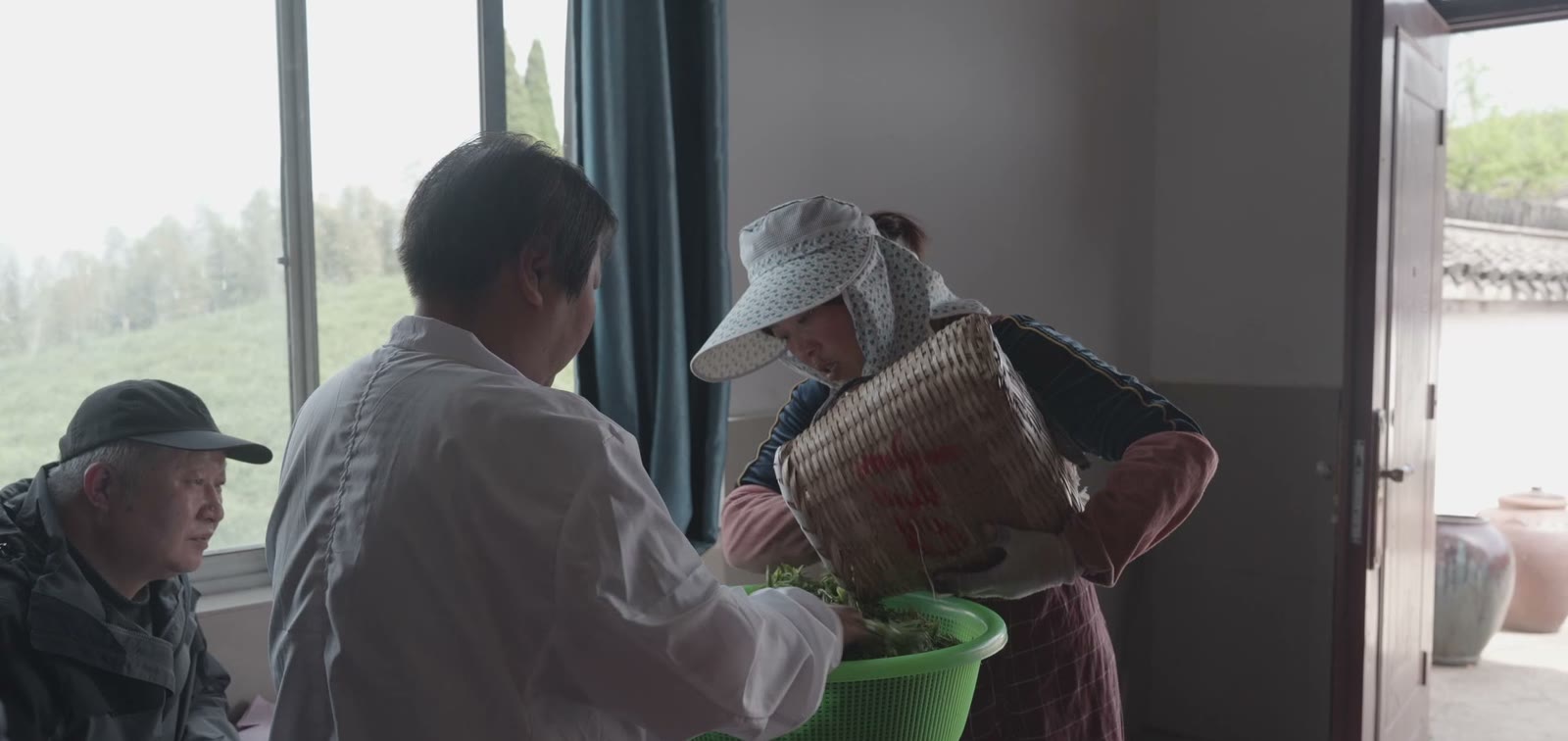
Observation: grading decides pay, and the grader is the buyer
Grade is assigned by the garden at the moment of weighing. A basket judged "grade two" is paid at a lower rate, and the decision is not appealable in practice. The picker's day is therefore priced by the party that pays her, against a standard she cannot verify. (03:10 to 04:49)
3.2 The calculator and the pay tickets
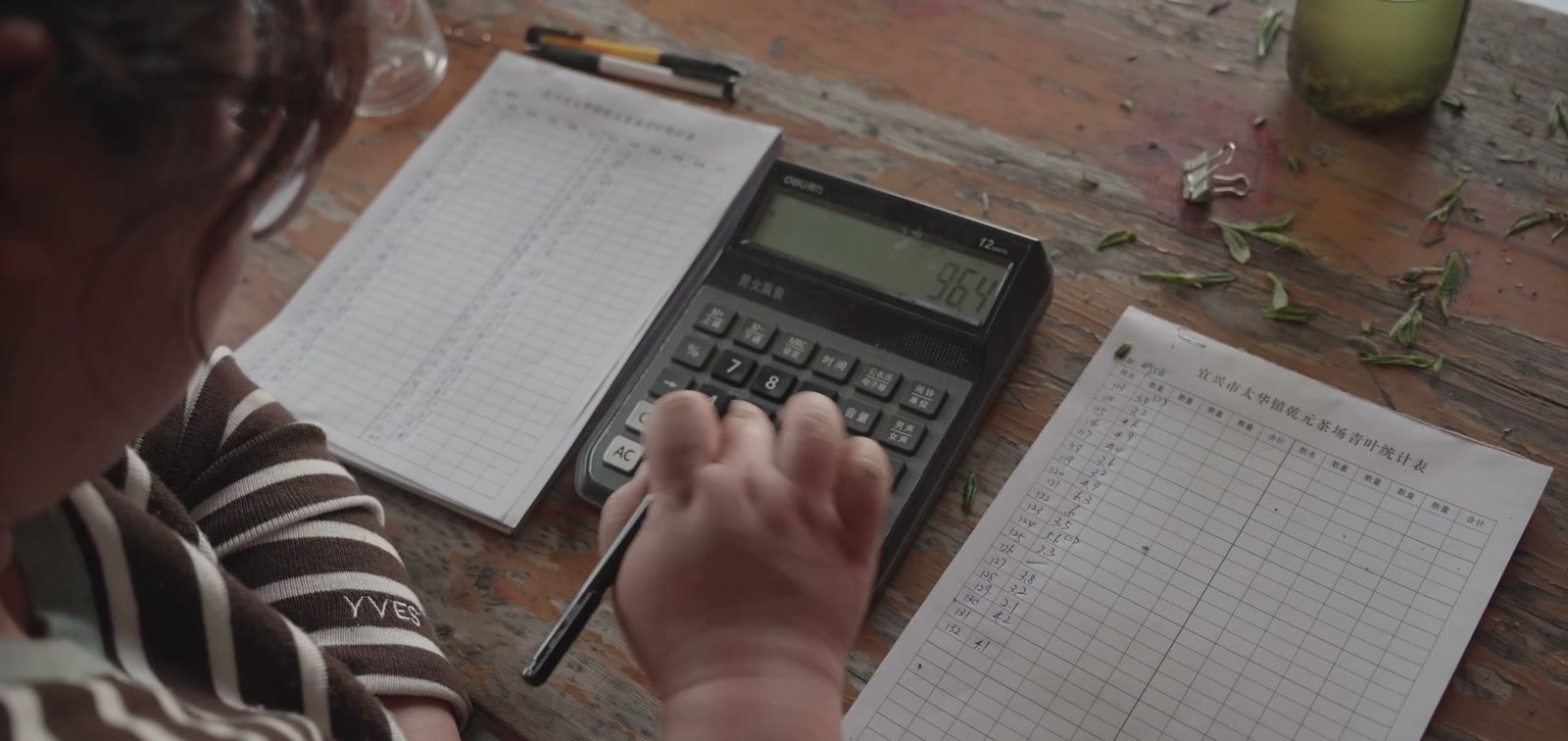
Pay is computed at the weigh-in. A basket is weighed ("four jin five liang"), the picker's number is noted ("number 40, we've marked it"), and the family warns that leaf not trimmed in the morning will be downgraded in the afternoon (03:43 to 04:21). Each picker's totals go into a ledger beside a calculator. The film shows the running sum being keyed in by hand (04:08).
The settlement arrangement differs for locals and migrants. Local households "settle by ticket": each delivery produces a ticket that is later redeemed. Migrant pickers are paid in one lump on the day they leave, and the foreman takes a headcount every night (05:42 to 06:20). The owner explains the custody of the tickets this way: "First, it's difficult to do it daily; second, it's risky for them to keep the tickets themselves; we total everything and pack it up, safe, right?" (approx. 06:00).
Observation: the record of what a woman is owed is held by the person who owes it
The pay tickets, the ledger and the calculator all sit with the garden. A migrant picker leaves at the end of the season with a lump sum computed from records she has not kept and may not be able to read. The arrangement is presented as being for her protection, and may well be, but it leaves her with no independent proof of her earnings and no leverage if the sum is disputed. (03:43 to 06:20)
3.3 The broker
The pickers did not find the garden themselves. A woman who describes herself as "the one who brings people in" has done it for twenty years. She was a picker first, "in Liyang for a few years, then in Yixing for more than ten years." The work is "one month a year, just one month." The owners contact her, and she finds people for them (16:03 to 16:39).
Observation: recruitment runs through a single intermediary, on trust
The broker is the pickers' only link to the garden and the garden's only link to the pickers. She negotiates nothing in writing. The arrangement is stable because it is personal and repeated, which is also what makes it impossible to audit. (16:03 to 16:39)
3.4 The day
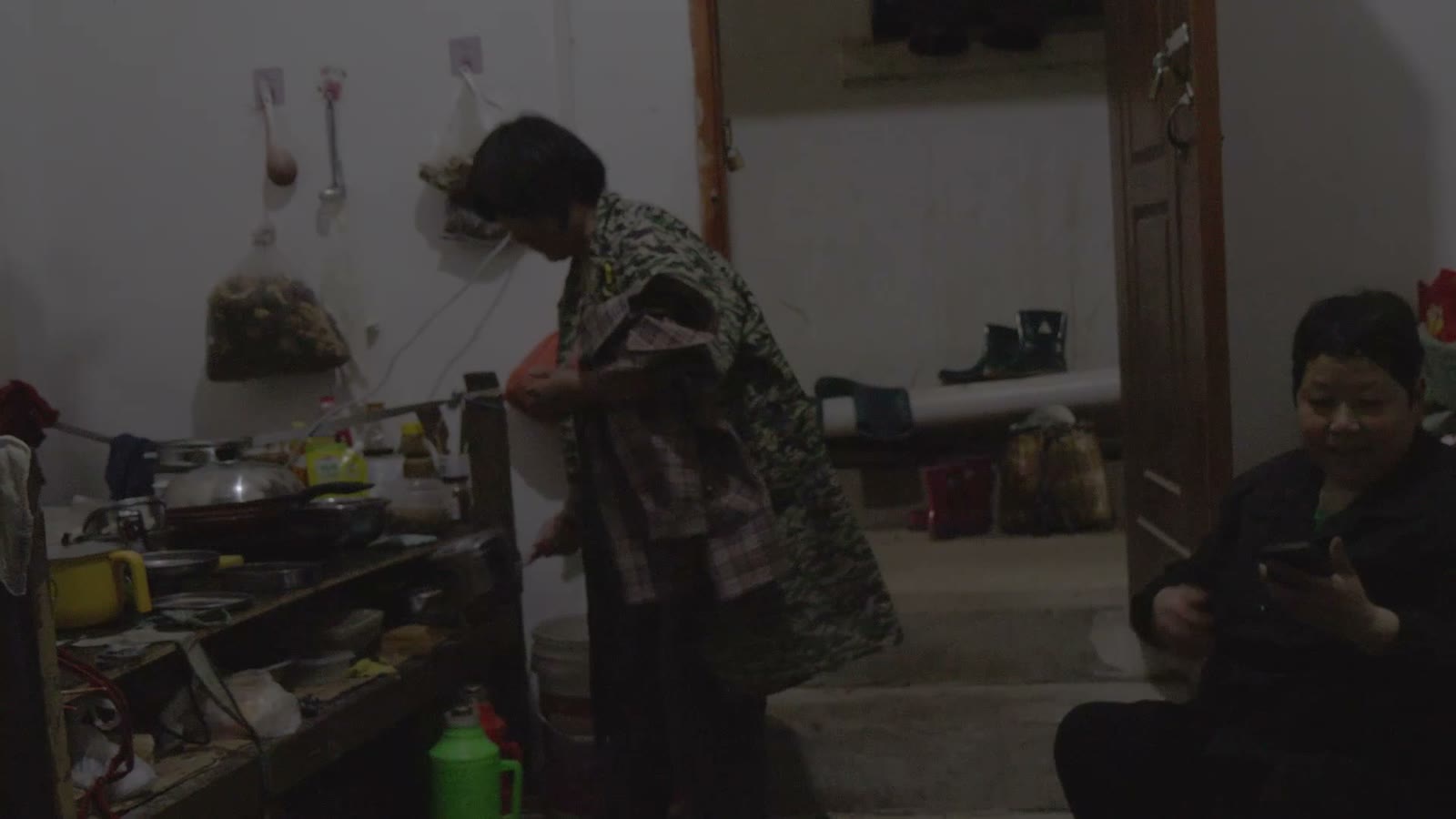
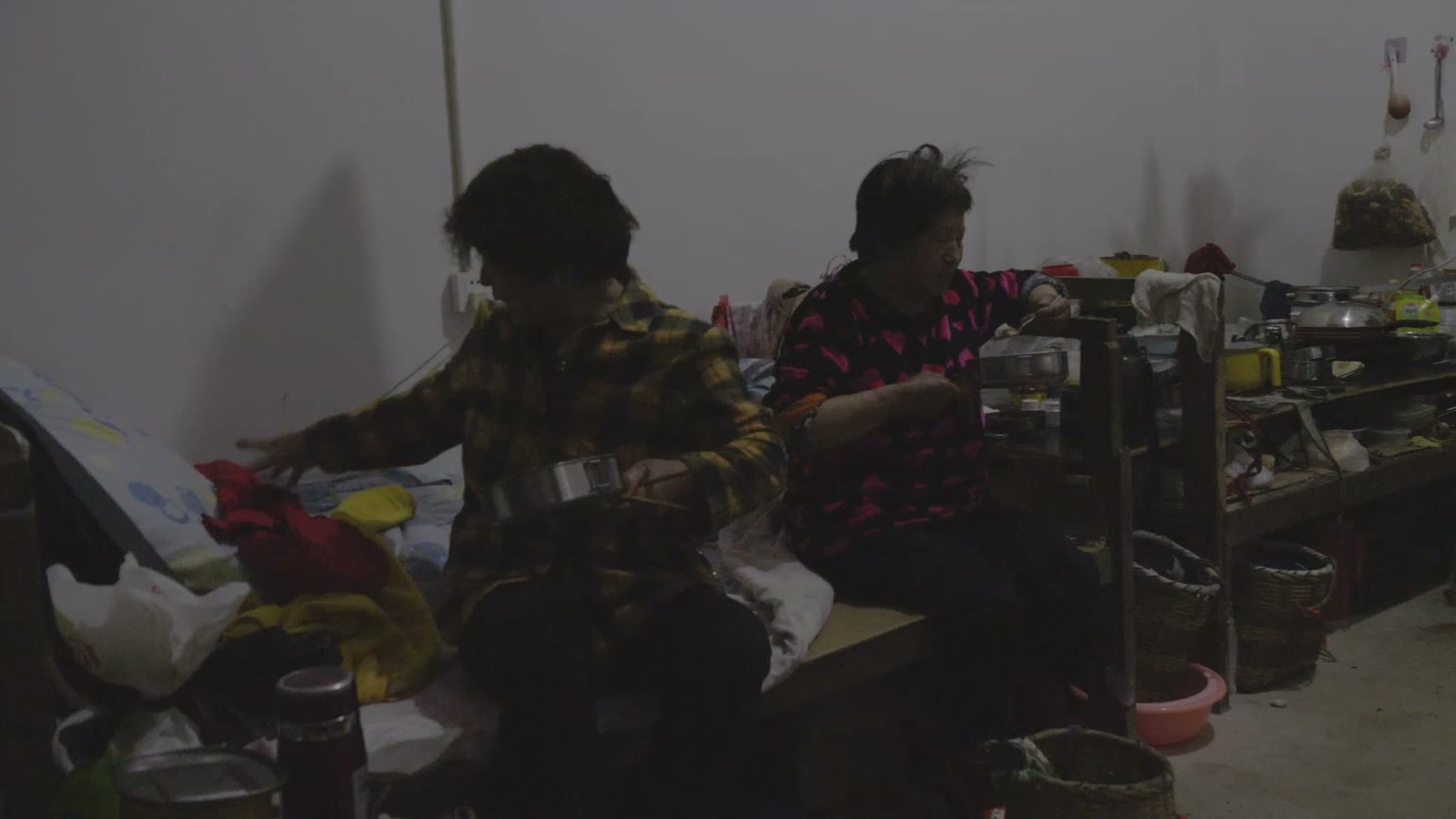
Work starts at six "because that is when it gets light"; morning leaf carries dew and picks more easily, and the garden still checks it for stray bits (18:07). Another picker says she has to get up at 4:30 and that the tea she is picking pays "thirty" a jin (21:59). Dinner for one woman is "a handful of rice a day" with a little cured meat. She has no pot. Others have pots and will not lend them, "though they're all from the same village" (11:53 to 12:25).
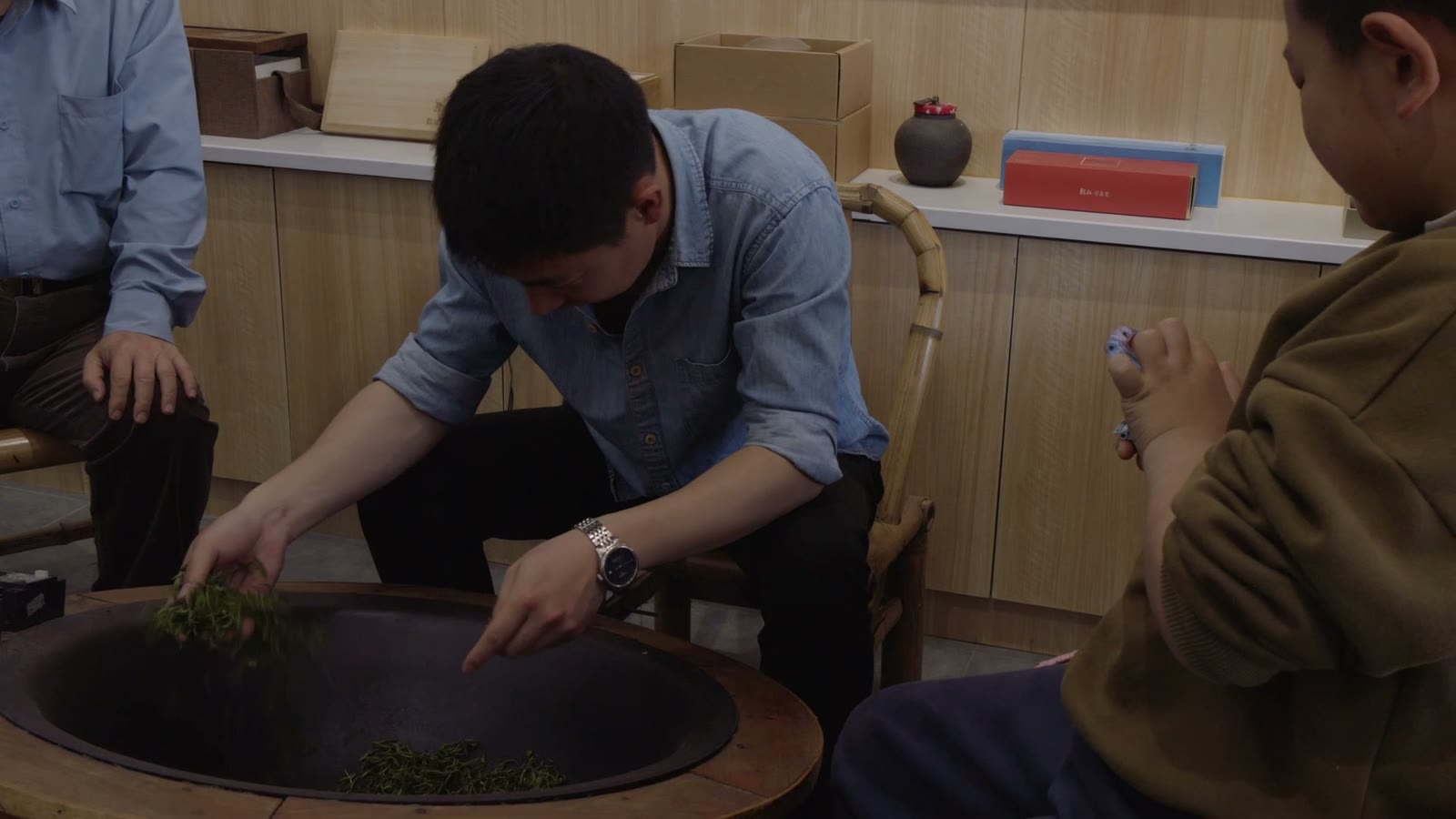
The frying lesson that opens the film explains why the processing side of the work is also skilled: the tea master works the hot wok by feel, with no hand cream, no perfume and no gloves, judging the temperature by touch (00:46 to 01:18, 02:19 to 02:54). Picking and frying are both crafts. Neither is paid as one.
3.5 Where they sleep
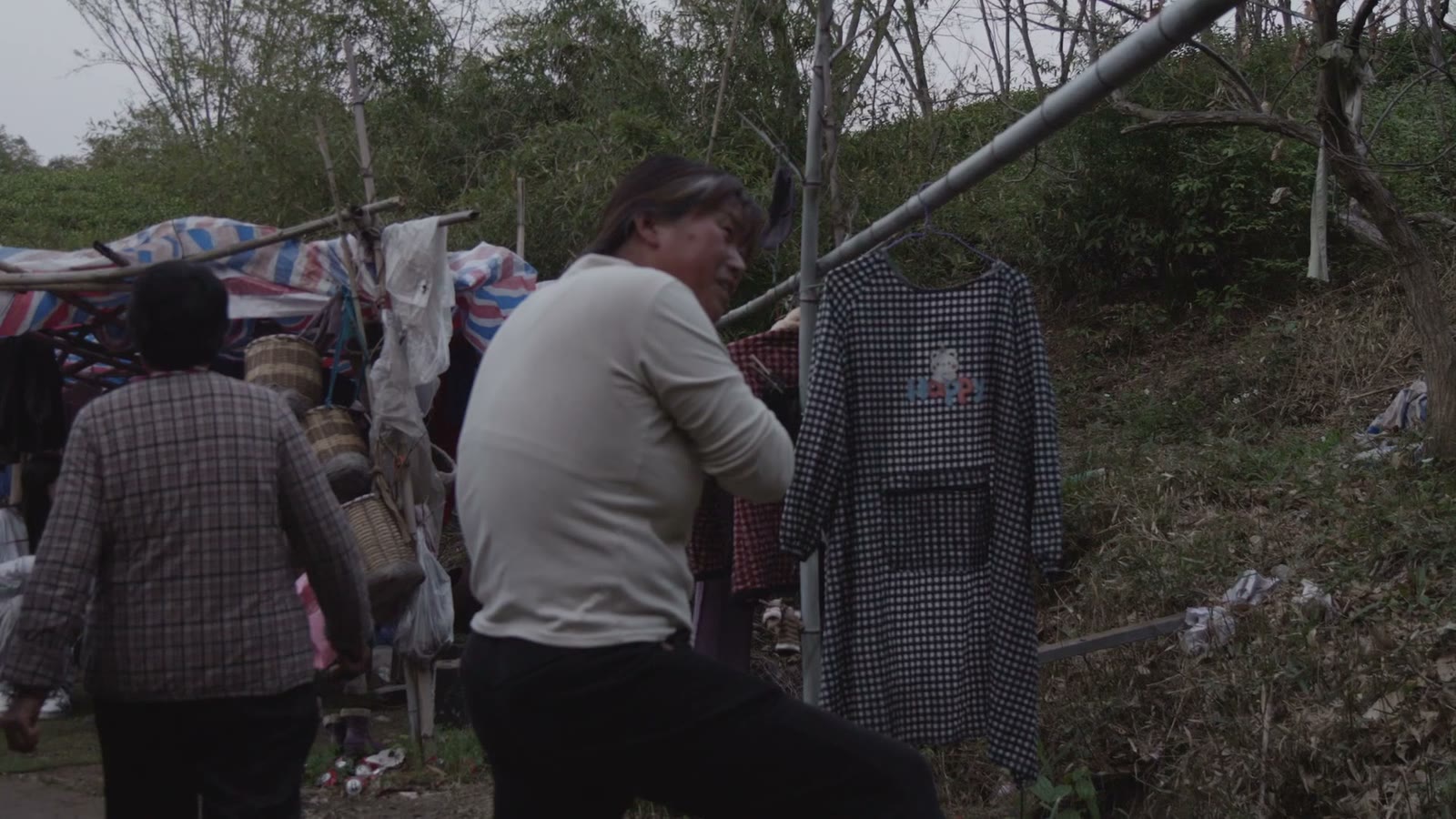
The housing recorded in the film ranges from a workers' shed to a tent. One picker shows her shelter: "not a house but a tent and a work shed, a pull-up shelter you can see straight through. When it rains, the rain and the wind come in" (22:24). Another group has been coming to the same factory for more than ten years. They used to sleep in the owner's villa; the villa has become a homestay for tourists, so they are now in a temporary shed put up beside it (23:38 to 24:12).
Observation: housing follows the garden's other uses of its buildings
There is no standard for picker housing in the places the film records. When a building finds a more profitable use, the pickers move to whatever is left. (22:24 to 24:12)
3.6 Why they come
The women's own account of why they do the work is the most important thing the film records. One has picked for seven years; she stayed home while her grandson was small, and now her granddaughter is going to university in Huangshan (11:15). Another has no tea fields of her own; the money "goes to the grandchildren" (16:49). Some of the oldest pickers are retired, and their adult children did not want them working; they came anyway, to ease the burden on a son (18:58). One, asked whether she would not rather enjoy life at home, answers: "Enjoy what? Our generation doesn't enjoy life. We've suffered all our lives. If you don't work, where does the food come from?" (20:54).
Observation: the season is a transfer to the next generation
In every account the film records, the money leaves the picker's hands: for a grandchild's schooling, a son's burden, a household's food. The picker herself is the last claimant on her own wage. (11:15, 16:49, 18:58, 20:54)
4Who picks China's tea: the published evidence
China is the world's largest tea producer, and the premium green tea that commands its highest prices is still picked by hand. This section assembles what official statistics, provincial agriculture departments, local governments, insurers, courts and peer-reviewed research say about the people who do that work: how many there are, where they come from, what they are paid, how long the season lasts and what it does to them. Where a widely circulated figure could not be traced to a primary source, it is not used.
4.1 The industry
In 2024 China had 52.4 million mu of tea gardens, about 3.5 million hectares, of which 47.6 million mu were in harvest. Output of crude tea was 3.50 million tonnes, up 4.8 percent on the year, while farm-gate output value fell 2.4 percent to 321.8 billion yuan.2 Output rose and value fell, so the value of each kilogram of leaf dropped; that is the squeeze inside which picker wages are set. Green tea, the hand-picked spring-flush category, was 59 percent of volume and 63 percent of value.2 Exports were 374,100 tonnes worth US$1.42 billion, down 18.4 percent in value.2
The only national headcount of pickers from an official body dates from 2020: a Ministry of Agriculture and Rural Affairs survey, reported by China News Service, counted over 70 million people working in tea, including about 26 million tea farmers, about 33 million tea pickers and more than 11 million in processing and distribution.3 Other estimates differ, and the figure includes anyone who picks, not only seasonal migrants; but it establishes the order of magnitude. Tea picking is one of the largest seasonal occupations in the country.
Machines have not replaced the hand. A 2026 engineering review states that bulk tea is harvested mechanically but premium tea "still relies mainly on hand-picking," and that picking robots remain at the prototype and demonstration stage with costs still above human labour.4 A 2022 field report put the gap simply: a robot needed three seconds per bud, a skilled picker took two buds a second.5
4.2 How many, and from where
The provincial figures are large. In 2022 the Zhejiang Department of Agriculture and Rural Affairs said the province needed 1.584 million pickers and was 145,000 short.5 Provincial data reported in 2025 show that under 3 percent of Zhejiang's pickers are under 35 and that 80 percent are cross-province migrants; in the West Lake core zone the shortfall reached 30 percent and the average age of one picking cohort was 58.6 Sixth Tone reported that Zhejiang draws in more than 800,000 seasonal workers each spring, "most of them older women from inland provinces like Anhui, Jiangxi, and Henan."7 Anji county alone takes in over 200,000 outside pickers a year.8 Xinyang, in Henan, estimated in 2020 that it needed about 1.5 million pickers at peak, of whom about 500,000 had to be brought in from outside; about 300,000 were recruited each year through fixed channels.9 10 Nanjing's gardens employ nearly 30,000 pickers each spring, almost half from outside the city, "generally women, average age about 55, the oldest 70."11
These pickers are largely invisible in national labour statistics. The National Bureau of Statistics counts a migrant worker as someone in local non-farm work or away from home for six months or more, so a three-to-six-week picking job is not captured; the 2024 survey found only 0.7 percent of China's 299.7 million migrant workers in the primary sector.12 The last agricultural census, in 2016, found women to be 47.5 percent of the 314 million people engaged in agricultural production, and a third of that workforce aged 55 or over.13 A 2025 study in the Collection of Women's Studies finds that family tea gardens in the Dabie Mountains are "increasingly run by women," with women aged 45 to 65 left behind as men migrate; the men earn around 40,000 yuan a year away, the women 5,000 to 10,000 from farming and picking.14
4.3 Recruitment: the broker
Much of the workforce is hired through intermediaries. In Anji, "besides direct contracts, many are hired through intermediaries," and the county court found that 90 percent of local tea labour disputes stemmed from unclear terms: unclear employer, unclear pay, missing insurance.8 In Songyang, Zhejiang, in 2018 the broker fee per picker reached 900 yuan, covering inbound travel and insurance; the guaranteed minimum was about 120 yuan a day, and pickers were paid only after a full month, "those who leave early get nothing"; nearly ten licensed brokers operated in one town, plus unlicensed ones.15 A 2026 Caixin report follows a team leader from Hebei whose group shrank from over 80 women to 34 in a year; an upstream broker in Henan sends the bus, and the brokers' walls advertise for "older workers: tea, goji, chili," so that the same women move from tea in March and April to garlic in May, goji in the northwest in July and August, and potatoes in Inner Mongolia in autumn.16 This is the migratory-bird pattern the first edition of this paper described, now documented across crops.
4.4 Pay, hours and the season
Day rates have risen but hours have not fallen. In Songyang in 2018 migrants earned 120 to 200 yuan a day against about 300 for locals.15 In Anhui in 2019 growers reported that picking labour had gone from 80 to 100 yuan a day to over 200, and that picking alone was now more than half of total tea cost.17 A 2022 Huangshan recruitment notice offered 170 yuan a day with room and board for about twenty days.5 In 2025, Hangzhou growers paid 200 a day, unchanged from 2024; in Meijiawu migrants were paid 180 against about 250 for locals working shorter hours; on the West Lake slopes the day ran to fourteen hours for at most 200 yuan.18 7 6 Piece rates in 2025 ran to nearly 300 yuan for two kilograms of fresh buds in Nanjing and 60 to 70 yuan a jin for good leaf in Wenzhou.11 19
Measured by the hour, the pay is below the legal minimum. Li and Li compute that a twelve-hour day for 150 to 200 yuan is 12.5 to 16.5 yuan an hour, under Anhui's 2024 minimum wage of 18 yuan an hour; about fifteen days of work yields about 2,500 yuan.14 The season is short: 25 to 26 days in a normal Hangzhou year, about 20 in 2025; 30 to 40 days in Jinzhai; about 15 days around Qingming in the Dabie Mountains.18 17 14 And it is fragile. In 2025 a winter drought followed by a heat spike in late March cut the Zhejiang harvest short; pickers who had earned over 5,000 yuan in previous seasons left with around 2,000, idle days were unpaid, and fifteen of the twenty migrant pickers at one Meijiawu garden packed their bags on the eve of Qingming.7 For women who, in the words of one 54-year-old, come because "the factories don't want us, and there's not much farmland back home," the season is half a year's income.7
4.5 What the work does to the body
Skilled pickers pick at least 40,000 to 50,000 buds a day, "which means the same motion is repeated 40,000 to 50,000 times"; half a kilogram of finished Yuhua tea takes about 60,000 buds.11 On the West Lake the motion is repeated over 50,000 times in a fourteen-hour day.6 Pickers in Hangzhou in 2025 reported heatstroke in the team and days frozen in single-digit temperatures, some working past two in the afternoon without eating.18 A 59-year-old picker from Jiande who worked twelve-hour days each Qingming was diagnosed with severe uterine prolapse, which her doctors linked to long-term labour.20 A picker at an Anji garden fell on the slope and suffered a comminuted fracture of the left tibia and fibula; the insurer that paid her 27,000 yuan notes that Anji's tea grows on hillsides and "accidents happen from time to time."21
There is also a disease risk specific to the hills. The National Disease Control and Prevention Administration names "farmers and tea pickers who work outdoors long-term" as a group at higher risk of tick bites and of severe fever with thrombocytopenia syndrome, a tick-borne infection for which there is no specific antiviral; cases run from April to October.22 In Dongyang, Zhejiang, 32 cases were recorded between 2017 and 2022 with 8 deaths, a fatality rate of 25 percent; 97 percent of patients were farmers and the spring peak, March to May, overlaps the tea harvest.23
What is missing is as telling as what is there. No epidemiological survey of hand, joint or back disease among Chinese tea pickers was found in the course of this research, and no study of pesticide exposure in the picking workforce. The injuries are visible in any garden and absent from the literature. That gap is itself a finding, and Recommendation 5 addresses it.
4.6 Insurance: what exists
Coverage is local, partial and recent. In Xinyang the insurance industry launched a picker-specific scheme in 2025 covering nearly 70,000 pickers against accidents and accident-related medical costs.24 Against the city's own 2020 estimate of 1.5 million pickers needed at peak, that is under 5 percent, though the two figures are five years apart and the larger includes local tea farmers.9 Anji county has bought a group accident policy for pickers since at least 2023; it runs for two months, pays 60,000 yuan per person for death or injury with an aggregate cap of 1 million yuan, excludes medical costs, and pays only "when no liable party can be found or the liable party cannot pay."25 With over 200,000 outside pickers in the county, the aggregate cap works out to about 5 yuan per picker. In 2025 the county court's standard labour-service contract made accident insurance a requirement on the tea firm; over 10,000 pickers have signed it.8 A Zhejiang broadcaster's summary of the West Lake season is blunt: pickers "lack social insurance and accident cover; high-intensity work contrasts with low returns."6
| Measure | Figure | Place, year | Source |
|---|---|---|---|
| People employed in tea, of whom pickers | 70 million; 33 million | National, 2020 | MARA survey via China News Service3 |
| Pickers needed; shortfall | 1.584 million; 145,000 | Zhejiang, 2022 | Provincial agriculture department5 |
| Pickers under 35; cross-province share | under 3%; 80% | Zhejiang, 2025 | Provincial data via China Blue News6 |
| Seasonal workers arriving each spring | over 800,000 | Zhejiang, 2025 | Sixth Tone7 |
| Average picker age | about 55; 58 | Nanjing; West Lake, 2025 | Nanjing agriculture bureau; China Blue News11 6 |
| Migrant day rate; local day rate | 180 to 200; about 250 | Zhejiang, 2025 | Sixth Tone7 |
| Hourly pay; provincial minimum wage | 12.5 to 16.5; 18 | Anhui, 2024 | Li and Li, Collection of Women's Studies14 |
| Season length | 15 to 40 days | Various, 2019 to 2025 | Tide News; Anhui Daily; Li and Li18 17 14 |
| Buds picked per day | 40,000 to 50,000 | Nanjing, 2025 | Nanjing agriculture bureau11 |
| Pickers insured; pickers needed | about 70,000; about 1.5 million | Xinyang, 2025; 2020 | Henan County Economy Net; People's Daily Henan24 9 |
5The protection gap: what Chinese social protection offers a seasonal picker
China has built the largest social insurance system in the world. By the end of 2025 it had 529 million people in the urban-rural resident pension, 942 million in resident medical insurance and 305 million in employment injury insurance.26 27 The question for this paper is narrower: what does that system actually deliver to a sixty-year-old woman from Anhui who picks tea in Jiangsu for a month each spring, is paid by the jin at a weigh-in, and is hired by a farming family through a broker? The answer, set out below, is that she is formally inside two of the three schemes and practically outside all of them.
5.1 Pension: enrolled, but at a level that cannot support her
Almost every rural woman over sixty is enrolled in the resident pension. Of the 529 million enrolled at the end of 2025, 188 million were drawing benefits, and over 70 percent of recipients are farmers.26 28 The benefit, however, is small. The national minimum basic pension was raised from 103 to 123 yuan a month in July 2024, the largest increase since the scheme began, then to 143 yuan in July 2025; the 2026 Government Work Report adds another 20 yuan, which state media report as 163 yuan.29 30 31 28 Dividing the scheme's 2025 fund spending by its recipients gives an average of roughly 276 yuan a month; the same arithmetic for the urban employee scheme gives roughly 3,900 yuan, about fourteen times more.26 The president of the China Social Security Association has said plainly that the resident basic pension "is insufficient to solve older people's basic source of livelihood."28
Against the 2025 rural per-capita disposable income of 24,456 yuan a year, a resident pension of 143 to 276 yuan a month covers between 7 and 14 percent of an average rural living.32 That is the arithmetic behind the picker who says she gets up at 4:30 because "when you're old, you can't make money at home" (Section 3.4). A month of picking at the Zhejiang average of 179 yuan a day earns in twenty days what the pension pays in a year.
5.2 Medical insurance: covered, with a bill she cannot absorb
Resident medical insurance is financed at 1,100 yuan per person a year, of which the state pays 700 and the individual 400; in 2026 the subsidy rises by 24 yuan while the individual share is unchanged.33 31 The scheme paid 66.0 percent of in-list inpatient costs in 2025, down from 68.6 percent in 2024, against 84.1 percent for employee-scheme members; at tertiary hospitals the resident rate was 61.7 percent.27 34 The average resident-scheme inpatient stay cost 7,339 yuan.27 At the 2025 reimbursement rate, at least about 2,500 yuan of an average stay is paid out of pocket before any item outside the reimbursement list, which is more than a month of average rural income.27 32
There is a catastrophic layer: by national rule its deductible may not exceed half of local per-capita income and it pays at least 60 percent, and medical assistance subsidised enrollment for 76.7 million people in 2025.35 27 For the registered rural poor the combined in-policy reimbursement exceeds 90 percent.33 A seasonal picker is usually neither registered poor nor catastrophically ill. She is in the broad middle, where one hospital stay for a fall on a wet slope costs more than her whole season.
5.3 Injury insurance: the scheme that does not reach the field
Employment injury insurance is the protection a picker most needs and the one she is least likely to have. The Regulations on Work-Related Injury Insurance apply to "employing units": enterprises, public institutions, social organisations and individual businesses with hired workers.36 A farming household that hires pickers is not on that list. The Ministry of Labour's standing interpretation of the Labour Law excludes "rural workers" other than township-enterprise employees and farmers working in cities, and the Labor Contract Law likewise applies only to organisations defined as employers.37 38 Guangdong's official reading is explicit that people without a labour relationship, including workers past retirement age, "fall outside the scope of the Work Injury Insurance Regulations."39
The legal part-time category does not help: it is defined as at most four hours a day and twenty-four a week, and peak-season picking runs to twelve.38 Nor does the 2021 guidance on new forms of employment, which created a middle category of workers "under labour management" without a full labour relationship; it is addressed to enterprises and platforms and tells flexible workers to join the resident schemes.40 At the end of 2025, 305 million people were insured against work injury out of 725 million employed, about 42 percent.26 32 Seasonal pickers are in the other 58 percent.
A Henan court case shows what this means in practice. In Luoshan County, Xinyang, a picker of nearly seventy fell ill during the harvest. The court treated her claim as a civil labour-service matter, not a labour dispute, and awarded 6,000 yuan of a 106,000-yuan claim. The judgment records that pickers in such cases are "mostly aged 55 to 65, usually primary-school educated or illiterate," and that "hiring by individuals requires no labour contract and no social insurance."41
5.4 Three doors that have opened, none of them onto a tea garden
Policy has moved in the last few years, in three directions that matter here.
Over-age workers. Several provinces let employers buy work-injury insurance alone for workers past retirement age: Zhejiang since 2018, capped at 65 for men but 60 for women, Guangdong since 2021 on a voluntary basis, and Shanghai since 2025 up to age 65.42 39 43 From 1 July 2026 a national interim rule requires employing units to enrol over-age workers in work-injury insurance, with the individual paying nothing, and promises separate injury measures still to be issued.44 Every one of these rules is addressed to an employing unit. A household garden that hires through a broker is not one.
Platform workers. The occupational injury pilot for new forms of employment began in July 2022 with seven platforms in seven provinces, reached 29.9 million cumulative enrollees by June 2026, and went nationwide on 1 July 2026. Its design, enrolment by the day and premiums by the order, is exactly what a four-week harvest needs.45 46 Agriculture is not a pilot sector.
Heat. The 2012 heat rules stop outdoor work at 40°C, cap it at six hours between 37 and 40°C, require a heat allowance at 35°C and bar pregnant workers from outdoor work at 35°C or above.47 They bind employing units. Spring picking rarely reaches those temperatures, but the summer and autumn tasks the same women do (Section 1) often do, and the rule does not reach a farm household either way.
The pattern is consistent. Each reform widens the definition of a worker who deserves injury cover, and each stops at the boundary of the formal employer. The 2025 and 2026 Central No. 1 Documents, the government's annual statement of rural policy, do not mention tea pickers, seasonal farm workers or rural women as a social-insurance group; the closest language is a call to "strengthen care and support for older migrant workers" and to expand the platform pilot.48 49
5.5 What counties have done on their own
Where the national schemes stop, some local governments have improvised. In Anji, Zhejiang, the county court found that 90 percent of tea labour disputes in three years came from vague terms, with no clear employer and no liability insurance; it issued a standard labour-service contract that requires tea firms to buy accident insurance for pickers, and more than 10,000 pickers have signed it.50 In Guzhang, Hunan, a community gig-labour market buys accident insurance for its 179-person picking team and pays a 20-yuan daily meal subsidy to those who work twenty days.51 In Huzhou, Zhejiang, the government fully funded a special insurance for pickers during the pandemic, described as a first in the province, though it covered isolation costs rather than injury.52
These are the seeds of the system this paper proposes. They are commercial accident policies attached to labour-service contracts, not social insurance; they depend on a county court or a community office choosing to act; and they cover thousands where the workforce is in the hundreds of thousands. But they prove that a per-picker, per-season policy can be written, priced and signed at scale, within one harvest.
| Scheme | Is she enrolled? | What it pays | Why it falls short |
|---|---|---|---|
| Resident pension | Usually yes | Minimum 143 to 163 yuan a month; average roughly 276 | About a tenth of rural living costs; a month of picking earns more than a year of pension |
| Resident medical insurance | Usually yes | 66% of in-list inpatient costs (61.7% at tertiary hospitals) | Average stay 7,339 yuan; at least about 2,500 out of pocket |
| Employment injury insurance | No | Nothing | Household employers are outside the Regulations; no labour relationship, no contract |
| Over-age worker rules (2026) | No | Injury cover, if the employer is an employing unit | A farm household is not an employing unit |
| Platform injury pilot | No | Per-day cover, per-order premium | Agriculture is not a sector in the pilot |
| County accident schemes (Anji, Guzhang) | Only where they exist | Commercial accident policy | Local, voluntary, small |
6How others protect comparable workers
China's seasonal pickers are not unusual. Every tea-producing country depends on a seasonal, mostly female, often migrant picking workforce, and several societies with ageing rural populations have had to decide how to treat older women who keep doing hard physical work past retirement age. This section looks at six settings: the certified-tea standards that already operate in Chinese gardens, the plantation economies of South Asia and East Africa, Korea's Jeju haenyeo, Japan's ageing farmers, the European Union's seasonal-worker regime, and the international labour standards that frame all of them. None is a template. Each contains one mechanism that could be transplanted.
6.1 Certified tea: a private standard that already counts seasonal workers
The Fairtrade Standard for Hired Labour, which governs certified tea estates, defines workers as "all workers including migrant, temporary, seasonal, sub-contracted and permanent workers." It requires a living wage reached by negotiated steps with worker representatives, at least eight weeks of maternity leave at not less than two-thirds pay, free tools and work clothes, free occupational healthcare, no hazardous work for pregnant or nursing women, and a Right to Unionise Guarantee communicated to seasonal workers "in their own language."53 Gender-based violence grievances go to women's committees with direct access to the chief executive.53 On top of the market price, Fairtrade pays a premium of US$0.50 per kilogram of CTC tea and US$1.10 for orthodox tea.54 For China, the price table sets tea terms only for small-producer cooperatives, not hired-labour estates; a Chinese garden that hires seasonal pickers through a broker is not a category the system prices.54
The Rainforest Alliance 2020 standard requires at least the national minimum wage for all workers, a yearly comparison of prevailing wages against a living-wage benchmark with a timed improvement plan where there is a gap, and registration of every worker category's wages in a salary matrix; downstream buyers are expected to co-fund the improvement plans.55
Two lessons follow. First, the mechanisms that Recommendation 4 proposes, a published wage record and a timed improvement plan, already exist in private standards that Chinese exporters use. Second, certification reaches a small share of tea: in 2022 Fairtrade counted 57,229 tea workers and 351,499 tea farmers worldwide, and producers can sell only a fraction of their crop on Fairtrade terms.56 57 A public rule is needed for the rest.
6.2 South Asia and East Africa: the plantation model and its limits
India's Plantations Labour Act of 1951 made the estate responsible for its workers' lives: housing for every resident worker and family, medical facilities the state could install at the employer's cost if the employer did not, crèches wherever fifty or more women worked, a 48-hour week with double-time overtime, umbrellas and raincoats against the weather, sickness and maternity allowances.58 Since 21 November 2025 those duties sit inside India's new labour codes, with a free annual health check for every employee.59 60 The cash wage, however, has stayed low: from 1 April 2026 Assam's daily rate is 280 rupees in the Brahmaputra Valley, which planters defend by pointing to the in-kind component.61 Oxfam's 2019 study of 510 workers on 50 Assam estates found women pluckers working thirteen-hour days for 110 to 130 rupees, half of them holding below-poverty-line ration cards, and 7 percent of the consumer price reaching estate workers.62 In Sri Lanka a January 2026 agreement raised the estate daily wage to 1,750 rupees; in Kenya the statutory agricultural minimum for 2026 is 385 shillings a day.63 64
The plantation model shows that housing, medical care and a working-time limit can be written into law as the employer's duty; it also shows that a legal duty without a living cash wage and without enforcement leaves workers poor. China's pickers are not on plantations; the equivalent of the estate is the county, and Recommendation 1 is written accordingly.
6.3 Korea: the Jeju haenyeo, older women's dangerous work made visible
The closest analogy to China's pickers in the region is the Jeju haenyeo, the women who free-dive for shellfish off Korea's southern island, "some aged in their 80s," diving ten metres without oxygen for up to seven hours a day, ninety days a year.65 UNESCO inscribed their culture in 2016, and credits it with advancing "women's status in the community."65 At the end of 2025 there were 2,371 active haenyeo, down from 4,377 in 2015 and a peak of 14,143 in 1970; 63 percent are aged 70 or over.66 67
What Jeju did with that recognition is the point. A 2017 provincial ordinance created an allowance for active divers over 70 and a settlement subsidy for new divers.68 For 2026 the province budgets 23.5 billion won across 29 programmes: medical costs covered up to 4 million won, a monthly allowance of 100,000 won for active divers over 70 and 200,000 over 80, explicitly "to reduce overexertion," a retirement allowance of 500,000 won a month for three years for divers who retire at 75 or older, and the same for new divers under 45.69 66 Fishing rights are held by local fishery cooperatives, so the women's associations sit inside the institution that controls the resource.65
Three transplantable mechanisms: a cultural-heritage listing that turned an invisible, dangerous, older-women's occupation into a named public concern; a cash allowance targeted by age and tied to the aim of reducing overwork; and medical cover specific to the occupation. Recommendation 5 draws on the first, Recommendations 1 and 3 on the second and third.
6.4 Japan: ageing farmers and the institutions built around them
Japan's core farmers averaged 67.7 years of age in the 2025 Census of Agriculture and Forestry, and women are 36.4 percent of them, a share that is falling.70 71 About 250 people die in farm-work accidents each year, and the rate per 100,000 workers is rising.72 Japan's response has three parts worth noting. The Farmers' Pension is open to anyone who farms sixty or more days a year, "including spouses, successors and other family members, farm employees and farm part-timers," on a funded defined-contribution basis with premiums chosen between 20,000 and 67,000 yen a month and a state subsidy for certified farmers.73 Self-employed farmers, who are outside the compulsory scheme, may join workers' accident insurance voluntarily through farm-work and machinery-operator groups.74 And since 2013 the Agriculture Women's Project has linked 1,131 women farmers with 45 companies and 10 organisations to develop products and services, while family business agreements on about 60,000 farms set working hours, holidays and wages for family members, including the women who do most of the farm's labour.71 75
The transplantable mechanism is the sixty-day threshold: a pension and an injury scheme that admit someone on the strength of two months' farm work a year, with no employer required to register her. That is the design of Recommendation 1.
6.5 Europe: the seasonal worker as a legal category
The European Union's Seasonal Workers Directive treats seasonal work as a category with its own rules. Stays are between five and nine months in any year; housing must ensure an adequate standard of living, with a written rental contract, rent that is "not excessive" and "not automatically deducted from the wage," and health and safety standards on the employer; seasonal workers have equal treatment on pay, working hours, leave, health and safety, freedom of association and collective bargaining, back pay and social security; and member states must provide complaint mechanisms that third parties can use on a worker's behalf.76
Italy's Law 199 of 2016 attacks the broker. Recruiting or employing workers in conditions of exploitation carries one to six years in prison and a fine of 500 to 1,000 euros per worker; exploitation is defined by four indicators, including repeated pay "manifestly different" from collective agreements, repeated violation of working-time rules, safety violations, and "degrading" housing.77 The same law created a register of compliant farms, the Rete del lavoro agricolo di qualità, run by the social security institute; farms on it must apply collective agreements and be current on contributions, inspections are steered toward farms outside it, and worker representatives sit on its board.78 Spain recruits seasonal farm workers at origin through its GECCO programmes: 25,767 in 2025, 81 percent from Morocco, 92 percent women, average age 43, 84 percent in Huelva; its 2026 minimum wage is 40.70 euros a day, and seasonal workers on contracts of 120 days or less must receive at least 57.82 euros per working day.79 80
Three mechanisms transplant. A housing rule that stops rent being silently deducted from pay. A positive register of compliant employers that shifts enforcement to those outside it, which is cheaper than inspecting everyone. And a statutory premium on the seasonal day rate that compensates for the absence of paid holidays and bonuses. Recommendations 2 and 4 use them.
6.6 The international floor
Agriculture is the most informal sector in the world: 93.6 percent of agricultural employment is informal globally, 94.7 percent in Asia and the Pacific, and in China 81.7 percent, rising to 83.2 percent for women, on the most recent ILO comparison.81 The ILO's Safety and Health in Agriculture Convention of 2001 has 23 ratifications; China is not among them.82 83 The ILO has published an intervention model for extending social protection to migrant seasonal agricultural workers, and its rural-economy policy notes include "Decent Work on Plantations," "Extending Social Protection to the Rural Economy" and "Empowering Women in the Rural Economy."84 85 The UN agencies' joint statement on rural women lists what decent work means for them: gender-equitable enforcement of labour standards, access to fair wages, improved occupational safety and social protection, and "strengthening rural women's voice in social dialogue with governments, employers and workers."86 Those four items are, in order, this paper's Recommendations 4, 2, 1 and 3, and 5.
| Setting | Mechanism | Borrowed in |
|---|---|---|
| Fairtrade, Rainforest Alliance | Seasonal workers counted as workers; wage record and timed improvement plan; buyers co-fund | Recommendation 4 |
| India, Plantations Labour Act | Housing, medical care and weather protection as the employer's legal duty | Recommendations 1, 3 |
| Korea, Jeju haenyeo | Heritage listing; age-targeted allowance to reduce overwork; occupation-specific medical cover | Recommendations 3, 5 |
| Japan, Farmers' Pension and accident insurance | Entry on sixty days' farm work a year, no employer needed; voluntary accident cover for the self-employed | Recommendation 1 |
| European Union directive | Housing standard; rent never deducted from pay; third-party complaints | Recommendations 2, 4 |
| Italy, Law 199/2016 | Register of compliant farms; inspection steered to the rest; broker exploitation a crime | Recommendations 2, 4 |
| Spain, minimum wage decree | Statutory premium on the seasonal day rate | Recommendation 2 |
7Five recommendations
The measures below are written to be adopted within one harvest cycle by the bodies that already touch a picker's season: the county government, the tea cooperative or factory, the labour broker, the retailer, and the provincial statistics and culture offices. Each states who acts, what changes for the picker, what it costs, and the precedent it rests on. They are ordered by urgency, not by ease.
Recommendation 1. Seasonal employment insurance: a per-picker, per-season policy
Who acts: county government with the provincial human resources and social security department; co-funded by gardens and factories that buy the leaf.
What. Every picker registered for the season at a collection point or by a broker is covered, for the harvest window, against accidental injury and death, acute illness during the season, and heat stress, with medical costs included. Enrolment is by the day and the premium is charged per registered picker, the design already used in the national occupational-injury pilot for platform workers.45 The policy is written in the picker's name, not the garden's, so it travels with her if she moves between gardens.
Why. Employment injury insurance does not reach pickers hired by farming households, and the 2026 rules for over-age workers still require an employing unit.36 44 The Anji scheme shows a county can buy group cover; it also shows the limits of a 1-million-yuan aggregate cap that excludes medical costs.25 Xinyang's 2025 scheme shows an insurer will write a picker-specific policy at scale.24 Japan admits anyone who farms sixty days a year to its pension and lets the self-employed buy accident cover without an employer.73 74
Cost. Commercial accident cover of the kind Anji and Xinyang bought is priced per head in the low tens of yuan for a season. Against a day rate of 180 to 200 yuan and a season of twenty days, a per-picker premium of that order is less than one percent of the wage bill.7 Counties should publish the premium and the claims paid each season.
First step. One tea county in Zhejiang, Jiangsu, Anhui or Henan runs the policy for the 2027 spring harvest, registering pickers at collection points, and reports enrolment and claims by June.
Recommendation 2. Collective contracts, posted rates and a mediator
Who acts: county court and justice bureau; cooperatives and factories; women's picker associations seeded through the Women's Federation.
What. A standard three-party seasonal contract, on the Anji model, between the picker, the broker and the garden or factory, that states the piece rate or day rate, the grading rule, the payment date, the housing provided and the insurance bought.8 Day rates, grading standards and payment dates are posted at the collection point where the leaf is weighed. Each picker keeps a copy of her ticket record; the garden keeps the other. Women's picker associations, organised by county or by sending village, negotiate a floor rate and rest periods before the season with the cooperatives and factories that hire them. Disputes go to a named mediator in the county's labour-service mediation channel within 48 hours.
Why. In Anji, 90 percent of tea labour disputes came from unclear terms, and a court-designed contract has been signed by over 10,000 pickers in its first season.8 The film records a pay system in which the record of what a woman is owed is held by the person who owes it (Section 3.2). In Songyang, brokers withheld all pay until the month was complete.15 The EU directive requires that rent never be deducted automatically from wages; Italy's register of compliant farms steers inspection to the rest; Spain fixes a statutory premium on the seasonal day rate.76 78 80 Fairtrade requires that steps toward a living wage be negotiated with worker representatives.53
Cost. Printing and a mediator's time. The contract exists; the posting board exists at every collection point.
First step. Provincial high courts in the four main green-tea provinces circulate the Anji contract to tea counties before the 2027 season; the Women's Federation convenes picker associations in the five largest sending counties.
Recommendation 3. Health care in the fields
Who acts: county health bureau and township health centres; provincial disease control.
What. For the harvest weeks, a mobile clinic visits the main picking districts on a posted schedule, with musculoskeletal screening, blood-pressure checks, wound care, heat-stress advice and tick-bite education, and refers serious cases to the county hospital with a note that triggers resident medical insurance and the catastrophic layer. The schedule and the reimbursement steps are posted at collection points and sheds. A one-page record of each picker's screening goes home with her.
Why. Pickers repeat the same motion 40,000 to 50,000 times a day, report heatstroke and days in single-digit cold, and are a named high-risk group for a tick-borne fever that killed a quarter of cases in one Zhejiang county, with a spring peak that overlaps the harvest.11 18 22 23 Resident medical insurance paid 66 percent of in-list inpatient costs in 2025 on an average stay of 7,339 yuan; the catastrophic layer and medical assistance exist but are rarely reached by a migrant far from her home county.27 35 India's plantation law made medical facilities the employer's duty; Jeju covers haenyeo medical costs to 4 million won.58 69 During the peak weeks the women are in one place; a clinic that comes to them reaches more people in a day than a county hospital does in a season.
Cost. A vehicle, a nurse and a doctor for four weeks per county. Screening data would also fill the gap this paper found: there is no published survey of hand, joint or back disease among Chinese tea pickers.
First step. Two counties pilot the clinic in 2027 and publish anonymised screening results.
Recommendation 4. A labor scorecard from tea brands and retailers
Who acts: tea retailers and brands; the China Tea Marketing Association; provincial market regulators.
What. Each brand publishes, once a year, for its spring tea: the day or piece rates paid to pickers in its supply gardens, the share of pickers insured, the housing and drinking-water standard provided, and the payment timing, in a common format set by the industry association. Buyers can then compare brands on labour as they already compare them on origin and grade. Brands that source from gardens on a county's register of compliant employers may say so.
Why. The numbers already exist on the pay tickets and in the factory ledger; nothing requires them to be published. Rainforest Alliance requires every worker category's wages in a salary matrix and a timed improvement plan co-funded by buyers; Fairtrade counts seasonal workers as workers and pays a premium per kilogram.55 53 54 Picking labour is more than half the cost of making tea, so the data are material to the product.17 Oxfam's finding that 7 percent of the consumer price of Assam tea reaches estate workers shows what a brand is being asked to disclose.62
Cost. One page a year. The format is the work; the association should publish it.
First step. The industry association publishes a draft format in 2027; three brands pilot it for the 2027 harvest.
Recommendation 5. Recognition: count them, name the craft, give them a seat
Who acts: National Bureau of Statistics and provincial statistics bureaus; county culture and tourism bureaus; the bodies that draft harvest-season policy.
What. Seasonal farm workers become a category in county labour statistics and in the migrant-worker monitoring survey, which today excludes anyone away for less than six months.12 Tea picking is listed as a skilled craft in county intangible-heritage programmes, which already celebrate tea making, with the pickers named as its bearers. Picker representatives, chosen by the associations in Recommendation 2, sit in the consultations that set harvest-season rules. Provincial disease control adds tea pickers as a monitored occupational group for musculoskeletal injury and tick-borne disease.
Why. What is not counted is not protected. The 2025 and 2026 Central No. 1 Documents do not mention seasonal farm workers or rural women as a group to insure.48 49 Jeju's heritage listing turned an invisible occupation of older women into a public concern with a budget line, and UNESCO credits it with raising women's status.65 69 Japan sets targets for women's share of agricultural committees and cooperative boards.71 The UN agencies name "strengthening rural women's voice in social dialogue" as a condition of decent work.86
Cost. A line in a survey form and a seat at a table.
First step. One province adds the category to its 2027 rural labour survey; one tea county lists picking in its heritage inventory with the pickers named.
| Recommendation | Who acts | What changes for the picker | Precedent |
|---|---|---|---|
| 1. Seasonal insurance | County, with gardens and factories | Covered by the day for injury, illness and heat, in her own name | Platform pilot; Anji; Xinyang; Japan |
| 2. Contracts and posted rates | Courts, cooperatives, picker associations | Rate and payment date she can see; a copy of her record; a mediator | Anji; EU directive; Italy; Spain; Fairtrade |
| 3. Health care in the fields | County health bureau | A clinic that comes to the garden; a referral that triggers her insurance | India; Jeju |
| 4. Labor scorecard | Brands, industry association | Her pay and conditions become part of the product | Rainforest Alliance; Fairtrade |
| 5. Recognition | Statistics bureaus, culture bureaus | Counted; named as a craft; represented | Jeju; Japan; UN agencies |
8Conclusion: from being seen to being protected
Modernization cannot be read from GDP figures or urban skylines alone. It must also be measured by how a society treats those who sustain it from the margins. The women who pick China's spring tea are not a stopgap. They are the skilled core of a 320-billion-yuan industry, and every piece of evidence this paper could find, from the agricultural census to a county court's judgment, says the same thing: the work is skilled, the workers are old, the season is short, and the protection is absent.
The argument of this paper is not that China lacks a social protection system. It is that the system was built around the formal employer, and the picker has none. She is enrolled in a pension that pays a tenth of a rural living and in a medical scheme that leaves her a month's income out of pocket for one hospital stay; she is outside the injury insurance that would matter most, because the household that hires her is not an "employing unit." Each recent reform has widened the circle of workers who deserve injury cover, and each has stopped at the same boundary. The platform pilot that now covers 30 million delivery riders by the day was designed for exactly her kind of work, and does not include her.
What the comparisons show is that the boundary can be moved. Japan admits a farmer to its pension on sixty days' work a year. Jeju pays an allowance to women over seventy so that they dive less. Anji wrote a contract that 10,000 pickers signed in one season. None of these required a new national law. They required a county, a court, a cooperative or a province to decide that the people in front of it were workers.
The five recommendations ask for that decision. Insure her for the season, by the day, in her own name. Put the rate on the wall and a copy of the record in her hand. Bring the clinic to the garden. Make her pay part of the product. Count her, name her craft, and give her a seat. Each can be done by the 2027 harvest in at least one county. Together they are what fair tea means.
The women in the film will go back to the hills next spring. One of them, asked whether she would not rather enjoy life at home, answered: "Enjoy what? Our generation doesn't enjoy life. We've suffered all our lives. If you don't work, where does the food come from?"1 That is the sentence this paper is written against. The harvest will be picked either way. The question is only whether the women who pick it will be seen, and then protected.
Acknowledgements and a note on evidence
The author thanks the pickers, the broker and the garden family in Yixing who allowed themselves to be filmed, and the student crew of The Weight of Tea. Every statistic in this paper is cited to a published source that was read in full on the date given in the references. Where a widely repeated figure could not be traced to a primary source, it has been left out, and three such figures that appeared in the first edition of this paper and in early campaign materials have been withdrawn. Derived figures, such as average pension benefits computed from fund spending, are marked as approximate. Corrections are welcome at hello@fairtea2030.com.
9References
- Molly Yuan (dir.), The Weight of Tea (苦与香), documentary, 28 min, Yixing, Jiangsu, 2026. Timestamps refer to the published cut. https://www.youtube.com/watch?v=PYVmF7s38OA
- China Tea Marketing Association (中国茶叶流通协会), 2024年度中国茶叶产销形势分析报告 [Analysis of China's tea production and marketing, 2024], April 2025. https://www.ctma.com.cn/zhuanyebaogao/82470.html
- Xiang Yipeng, "中国茶产业从业人员超7000万人 助力脱贫攻坚" [Over 70 million people work in China's tea industry], China News Service, 12 September 2020, reporting a Ministry of Agriculture and Rural Affairs survey. https://news.sina.cn/2020-09-12/detail-iivhuipp4000735.d.html
- Yang Jinpeng et al., "名优茶采摘机器人关键技术研究现状与发展趋势" [Research status and trends in key technologies for premium-tea picking robots], Journal of Chinese Agricultural Mechanization 47(2), 2026, pp. 148-156. https://www.cabidigitallibrary.org/doi/pdf/10.5555/20260121979
- Gong Chiping, "浙江采茶工不够,机器人来凑,还流行“共享员工”" [Zhejiang short of pickers: robots and shared workers fill in], Shangguan News (Jiefang Daily), 4 April 2022, citing the Zhejiang Department of Agriculture and Rural Affairs. https://www.jfdaily.com/wx/detail.do?id=468731
- China Blue News (Zhejiang Radio and Television), "西湖茶山来了AI“采茶工” 能否破解“春茶困局”?" [AI pickers come to the West Lake tea hills], 27 April 2025, citing Zhejiang Department of Agriculture and Rural Affairs data. https://www.hzsc.com.cn/content/content_9793145.html
- Chen Yiru, "In China's Tea Heartland, Workers Pick Through Climate Whiplash," Sixth Tone, 15 May 2025. https://www.sixthtone.com/news/1017097
- Wang Yanqi, "安吉采茶工有了标准化劳务合同" [Anji tea pickers get a standard labour-service contract], Huzhou Daily, 28 March 2025. https://finance.sina.com.cn/roll/2025-03-28/doc-inerczxw0102471.shtml
- People's Daily Online, Henan, "大别山区茶飘香" [Tea fragrance in the Dabie Mountains], 16 March 2020, quoting the director of the Xinyang Forestry and Tea Bureau. http://henan.people.com.cn/n2/2020/0316/c378397-33879475.html
- China National Radio, "河南信阳:采茶期将至急缺采茶工 各部门着手应对" [Xinyang, Henan: picking season nears with an acute shortage of pickers], 7 March 2020. http://news.cnr.cn/native/city/20200307/t20200307_525007254.shtml
- Nanjing Municipal Bureau of Agriculture and Rural Affairs, reprinting Nanjing Daily, "采茶季到,上万名“采茶阿姨”又来了" [Picking season: tens of thousands of “picking aunties” are back], 27 March 2025. https://nyncj.nanjing.gov.cn/nygzdt/202503/t20250325_5102707.html
- National Bureau of Statistics, 2024年农民工监测调查报告 [2024 Migrant Worker Monitoring Survey Report], 30 April 2025. https://www.stats.gov.cn/zwfwck/sjfb/202504/t20250430_1959523.html
- National Bureau of Statistics and Office of the Leading Group for the Third National Agricultural Census, 第三次全国农业普查主要数据公报(第五号) [Communiqué on major data of the Third National Agricultural Census, No. 5], 16 December 2017. https://www.stats.gov.cn/sj/tjgb/nypcgb/qgnypcgb/202302/t20230206_1902105.html
- Li Jie and Li Shumin, "弹性关系的搭建:大别山区家庭茶园女性采茶佣工关系研究" [Building flexible relations: women tea-picking labour in family tea gardens of the Dabie Mountains], Collection of Women's Studies (妇女研究论丛) 2025(2), pp. 46-59; read via a full-text repost, page numbers to be confirmed against the journal. https://zhuanlan.zhihu.com/p/2025737354875249988
- Chen Jian, "浙江松阳:采茶工紧缺 日均150元仍难招人" [Songyang, Zhejiang: pickers scarce, hard to hire even at 150 yuan a day], Xinhua, 2 April 2018. https://finance.sina.cn/2018-04-02/detail-ifysvnik6001173.d.html
- Zheng Haipeng, "显影|住工棚喝雨水少肉吃:“候鸟”采茶工的季节远征" [Living in sheds, drinking rainwater, little meat: the seasonal expedition of migratory tea pickers], Caixin Weekly, 24 April 2026 (opening section). https://weekly.caixin.com/m/2026-04-24/102437349.html
- Yu Hansong, "记者调查:茶叶人工成本持续攀升" [Reporter's investigation: tea labour costs keep climbing], Anhui Daily group (安徽党媒云), 19 March 2019. http://lbr.ahnews.com.cn/news/2019/03/19/c_9913.htm
- Teng Yitao, "茶忙季接近尾声,采茶工有的在做最后冲刺,也有人节前就已返乡" [As the tea season ends, some pickers make a final push, others have gone home], Qianjiang Evening News / Tide News, 6 April 2025. https://m.sohu.com/a/880478839_121627717
- Xie Chunhui, "浙江进入春茶季,第一批采茶工已上线" [Zhejiang enters the spring tea season; the first pickers are at work], Tide News via Zhejiang Online, 17 February 2025. https://zjnews.zjol.com.cn/zjnews/202502/t20250217_30832042.shtml
- Beijing Evening News, citing Qianjiang Evening News, report on a 59-year-old tea picker from Jiande diagnosed with severe uterine prolapse, 7 April 2025. https://finance.sina.com.cn/jjxw/2025-04-07/doc-inesifvx4609084.shtml
- China Life Insurance, "做好“生态文章” 激活“绿色引擎”" [company news on tea-picker accident cover in Anji], 4 September 2025. https://www.e-chinalife.com/c/2025-09-04/1eb8c0be-2246-426a-9080-1855bb7e85d1.shtml
- National Disease Control and Prevention Administration, "发热伴血小板减少综合征防控知识问答" [Questions and answers on preventing severe fever with thrombocytopenia syndrome]. https://www.ndcpa.gov.cn/jbkzzx/c100040/common/content/content_2036684724942311424.html
- Chen Kang et al. (Dongyang Center for Disease Control), "东阳市发热伴血小板减少综合征病例特征分析" [Characteristics of SFTS cases in Dongyang], Preventive Medicine (预防医学) 36(1), 2024, pp. 47-50. https://www.zjyfyxzz.com/CN/abstract/abstract2799.shtml
- Liu Xueyou, "信阳保险业全力护航春茶采摘 筑牢产业发展风险屏障" [Xinyang insurers back the spring tea harvest], Henan County Economy Net (Henan Radio and Television), 14 April 2025. https://m.henance.com/xinyang/show-75027.html
- Anji County Bureau of Agriculture and Rural Affairs, 关于开展2023年采茶工政府扶贫救助保险的通知 (安农〔2023〕19号) [Notice on the 2023 government relief insurance for tea pickers], 17 March 2023. https://www.anji.gov.cn/xxgk/bmxxgk/xnyncj/fdzdgknr/zcfg/xzbmwj/art/2025/art_7264867957984e6418c6665076ec02dd.html
- Ministry of Human Resources and Social Security, 2025年度人力资源和社会保障事业发展统计公报 [2025 Statistical Bulletin on the Development of Human Resources and Social Security], 16 July 2026. http://114.255.111.180/SYrlzyhshbzb/zwgk/szrs/tjgb/202607/W020260810605568278568.pdf
- National Healthcare Security Administration, 2025年全国医疗保障事业发展统计公报 [2025 Statistical Bulletin on Healthcare Security], 16 July 2026. https://www.nhsa.gov.cn/art/2026/7/16/art_7_21451.html
- China National Radio (央广网), from China Youth Daily, "再提高20元 城乡居民养老金进入加快提升阶段" [Another 20 yuan: resident pensions enter a phase of faster increases], 9 March 2026. https://www.cnr.cn/mspd/sywzl/20260309/t20260309_527546899.shtml
- 中国社会保障 [China Social Security], "2024年度中国社会保障十大新闻" [Top ten social security news of 2024], reposted by Ali Prefecture Human Resources and Social Security Bureau, 21 January 2025. https://hrss.al.gov.cn/info/2093/15202.htm
- Liaoning Provincial Department of Finance, "我省城乡居民基本养老保险基础养老金最低标准提高20元" [Our province raises the minimum basic pension by 20 yuan], 11 September 2025. https://czt.ln.gov.cn/czt/zxzx/czxw/2025091116572256824/index.shtml
- State Council, 政府工作报告 [Report on the Work of the Government], delivered 5 March 2026; full text via Xinhua, reposted by the Ministry of Justice, 13 March 2026. https://www.moj.gov.cn/pub/sfbgw/zwgkztzl/2026nianzhuanti/2026qglh0206/lhjj20260206/lhjjyw20260206/202603/t20260313_532786.html
- National Bureau of Statistics, 中华人民共和国2025年国民经济和社会发展统计公报 [Statistical Communiqué on the 2025 National Economic and Social Development], 28 February 2026. https://www.stats.gov.cn/sj/zxfbhjd/202602/t20260228_1962662.html
- National Healthcare Security Administration, "2018-2025年中央财政累计为医疗保障投入超3万亿元" [Central finance has put over 3 trillion yuan into healthcare security, 2018 to 2025], 17 December 2025. https://www.nhsa.gov.cn/art/2025/12/17/art_14_19054.html
- National Healthcare Security Administration, 2024年全国医疗保障事业发展统计公报 [2024 Statistical Bulletin on Healthcare Security], 14 July 2025. https://www.nhsa.gov.cn/art/2025/7/14/art_7_17248.html
- National Healthcare Security Administration and Ministry of Finance, 关于建立医疗保障待遇清单制度的意见 (医保发〔2021〕5号) [Opinions on establishing a healthcare security benefit list system], 2021. https://www.nhsa.gov.cn/art/2021/8/10/art_37_5767.html
- State Council, 国务院关于修改〈工伤保险条例〉的决定 (国务院令第586号) [Decision on amending the Regulations on Work-Related Injury Insurance], 20 December 2010, State Council Gazette. https://www.gov.cn/gongbao/content/2011/content_1778064.htm
- Ministry of Labour, 关于贯彻执行〈中华人民共和国劳动法〉若干问题的意见 (劳部发〔1995〕309号) [Opinions on several questions in implementing the Labour Law], 1995, as posted by Wuhai Human Resources and Social Security Bureau. http://rsj.wuhai.gov.cn/rsj/733324/733370/flfg69/1163386/index.html
- 中华人民共和国劳动合同法 [Labor Contract Law of the People's Republic of China], Articles 2 and 68 to 72, as posted by the National Public Complaints and Proposals Administration. https://www.gjxfj.gov.cn/gjxfj/xxgk/fgwj/flfg/webinfo/2016/03/1460585589931971.htm
- Shenzhen Human Resources and Social Security Bureau, interpretation of Guangdong's 关于单位从业的超过法定退休年龄劳动者等特定人员参加工伤保险的办法(试行) [Trial measures on work-injury insurance for over-age workers and other specified persons employed by units], 2 April 2021. https://hrss.sz.gov.cn/xxgk/zcfgjjd/zcfg/zcjd/content/post_8669828.html
- Ministry of Human Resources and Social Security and seven other departments, 关于维护新就业形态劳动者劳动保障权益的指导意见 (人社部发〔2021〕56号) [Guiding opinions on protecting the labour rights of workers in new forms of employment], 2021. https://www.mem.gov.cn/gk/zfxxgkpt/fdzdgknr/202201/P020220119421220937140.pdf
- Luoshan County People's Court, "信阳市罗山法院:采茶工采茶期间突发疾病,谁之过?" [Luoshan court, Xinyang: a tea picker falls ill during the harvest, whose fault?], Henan High People's Court website, 25 May 2023. https://www.hncourt.gov.cn/public/detail.php?id=195622
- Zhejiang Department of Human Resources and Social Security and two other departments, 关于试行职业技工等学校学生在实习期间和已超过法定退休年龄人员在继续就业期间参加工伤保险工作的指导意见 [Guiding opinions on trial work-injury insurance for student interns and persons continuing to work past retirement age], 18 July 2018; text via a policy database, official original not retrieved. https://zc.51shebao.com/detail/818170
- Shanghai Human Resources and Social Security Bureau and three other departments, 关于本市超过法定退休年龄就业人员和实习生参加工伤保险的实施意见 (沪人社规〔2025〕22号) [Implementing opinions on work-injury insurance for workers past retirement age and interns], 10 September 2025. https://shanghai.chinatax.gov.cn/zcfw/zcfgk/sbf/202511/t478312.html
- Ministry of Human Resources and Social Security and four other departments, 超龄劳动者基本权益保障暂行规定 [Interim Provisions on Protecting the Basic Rights of Workers Past Retirement Age], issued 25 May 2026, in force 1 July 2026; text as reposted by the State Taxation Administration, Shanghai. https://shanghai.chinatax.gov.cn/zzzb/zcwj/202605/t480421.html
- Ministry of Human Resources and Social Security, "7月1日起职业伤害保障试点向全国推开" [From 1 July the occupational injury protection pilot is extended nationwide], 7 July 2026. https://chrm.mohrss.gov.cn/7%E6%9C%881%E6%97%A5%E8%B5%B7%E8%81%8C%E4%B8%9A%E4%BC%A4%E5%AE%B3%E4%BF%9D%E9%9A%9C%E8%AF%95%E7%82%B9%E5%90%91%E5%85%A8%E5%9B%BD%E6%8E%A8%E5%BC%80/
- He Canchun (贺灿春), "在平台经济中守护新就业形态劳动者" [Protecting workers in new forms of employment in the platform economy], China Center for Insurance and Social Security Research, Peking University. https://econ.pku.edu.cn/ccissr/bdbxpl/50161zgbxy390335.htm
- State Administration of Work Safety, Ministry of Health, Ministry of Human Resources and Social Security and All-China Federation of Trade Unions, 防暑降温措施管理办法 (安监总安健〔2012〕89号) [Administrative measures on heatstroke prevention], 29 June 2012. https://www.nhc.gov.cn/zhjcj/s5852/201207/9871e8d92f1f4964975ad56bdeac94af.shtml
- CPC Central Committee and State Council, 关于进一步深化农村改革 扎实推进乡村全面振兴的意见 [Opinions on further deepening rural reform and advancing rural revitalisation] (2025 Central No. 1 Document), 23 February 2025. https://www.12371.cn/2025/02/23/ARTI1740305225630223.shtml
- CPC Central Committee and State Council, 关于锚定农业农村现代化扎实推进乡村全面振兴的意见 [Opinions on anchoring agricultural and rural modernisation and advancing rural revitalisation] (2026 Central No. 1 Document), February 2026, as reposted by the Hubei Department of Agriculture and Rural Affairs. http://nyt.hubei.gov.cn/bmdt/ztzl/zxzt/fzxxtjjj/202602/t20260210_5874636.shtml
- Zhejiang Legal Daily, "权责清晰还嵌入保险和纠纷调解程序 安吉上万采茶工签下标准化劳务合同" [Clear rights and duties, insurance and mediation built in: over ten thousand Anji tea pickers sign a standard labour-service contract], via 平安浙江网, 26 March 2025. http://www.pazjw.gov.cn/gongchuangpingan/202503/t20250326_30903039.shtml
- Hunan Daily (新湖南), "古丈坪社区零工市场“古丈茶工”采茶队:以工助茶 以茶富民" [The Guzhang tea-picking team of the Guzhangping community gig market], 10 April 2026. https://m.voc.com.cn/rmt/article/16262995.html
- Ministry of Finance, Zhejiang finance bulletin, "浙江省湖州市财政:抛出“撒手锏”“供氧”全市春茶生产" [Huzhou finance backs the city's spring tea production], 28 April 2020. http://www.mof.gov.cn/zhengwuxinxi/xinwenlianbo/zhejiangcaizhengxinxilianbo/202004/t20200428_3505834.htm
- Fairtrade International, Fairtrade Standard for Hired Labour, version 2.4, 16 April 2024, with 2025 additions. https://www.fairtrade.net/content/dam/fairtrade/fairtrade-international/standards/hired-labour-/HL_EN.pdf
- Fairtrade International, Fairtrade Minimum Price and Fairtrade Premium Table, version of 24 September 2025 (tea rows valid from 21 December 2020). https://www.fairtrade.net/content/dam/fairtrade/global/minimum-price-table/Master_To%20do%20PDFs_Fairtrade_Minimum_Price_and_Premium_Table_EN_PUBLIC.pdf
- Glover, D. et al., Dispositions Towards the Living Wage Proposition: Baseline Report of the Rainforest Alliance Living Wage Strategy Evaluation, c. 2024. https://www.researchgate.net/profile/Dominic-Glover/publication/377845679
- Fairtrade International, Monitoring the Scope and Benefits of Fairtrade: Overview, 15th edition (data year 2022). https://www.fairtrade.net/content/dam/fairtrade/fairtrade-switzerland/studien/de/b1%20Fairtrade-monitoring-report-overview-15th-edition.pdf
- Fairtrade International, Monitoring the Scope and Benefits of Fairtrade: Tea, Monitoring Report, 10th edition, 20 August 2019. https://www.fairtrade.net/en/get-involved/library/monitoring-the-scope-and-benefits-of-fairtrade--tea---monitoring.html
- Government of India, The Plantations Labour Act, 1951 (as amended), Tea Board copy. https://www.teaboard.gov.in/pdf/policy/Plantations%20Labour%20Act_amended.pdf
- Press Information Bureau, Ministry of Labour and Employment, India, "Welfare of Plantation Workers," Lok Sabha reply, release 2200431, December 2025. https://www.pib.gov.in/PressReleasePage.aspx?PRID=2200431
- Press Information Bureau, India, factsheet "Occupational Safety, Health and Working Conditions (OSH) Code, 2020." https://www.pib.gov.in/FactsheetDetails.aspx?Id=150475
- Borthakur, R., "Tea garden workers in Assam to get Rs 30 interim wage hike from April 1," The Assam Tribune, 10 March 2026. https://assamtribune.com/assam/tea-garden-workers-in-assam-to-get-rs-30-interim-wage-hike-from-april-1-1609247
- Oxfam India, "Addressing the Human Cost of Assam Tea," press release, 10 October 2019. https://www.oxfamindia.org/press-release/oxfam-calls-consumers-and-supermarkets-improve-assam-tea-sector
- Newsfirst (Sri Lanka), "New Deal Seals Salary Hike for Plantation Workers," 30 January 2026. https://www.newsfirst.lk/2026/01/30/new-deal-seals-salary-hike-for-plantation-workers
- Grant Thornton Kenya, Wages Guide 2026, reproducing the Regulation of Wages (Agricultural Industry) (Amendment) Order, 2026, effective 1 May 2026. https://www.grantthornton.co.ke/globalassets/1.-member-firms/kenya/insights/pdf/wages-guide-2026.pdf
- UNESCO Intangible Cultural Heritage, "Culture of Jeju Haenyeo (women divers)," element 01068, inscribed 2016. https://ich.unesco.org/en/RL/culture-of-jeju-haenyeo-women-divers-01068
- Park Mi-Ra, "‘Jeju haenyeo lineage may be broken’: About 250 fewer than a year earlier, again," The Kyunghyang Shinmun, 20 January 2026, reporting Jeju Province data. https://www.khan.co.kr/en/article/202601201436577
- Lee, M. and Lee, S.-J., "As Jeju's ‘haenyeo’ numbers sink, young recruits dive in to save tradition," Korea JoongAng Daily, 17 May 2026. https://www.koreajoongangdaily.com/lifestyle/as-jejus-haenyeo-numbers-sink-young-recruits-dive-in-to-save-tradition/12596927
- Seoul Shinmun, "제주 고령 해녀 월 20만원 수당 받는다" [Older Jeju haenyeo to receive a 200,000-won monthly allowance], 19 May 2017, on the provincial ordinance as passed in committee. https://m.go.seoul.co.kr/news/2017/05/19/20170519014004
- Seoul Shinmun, "1년만에 2500명선도 붕괴된 제주해녀… 고령화 대응 의료 안전지원 확대" [Jeju haenyeo fall below 2,500 in a year; medical and safety support expanded for an ageing workforce], 20 January 2026. https://www.twig24.com/news/2026/01/20/20260120500120
- Ministry of Agriculture, Forestry and Fisheries (Japan), Tohoku Regional Agricultural Administration Office, "MAFF NAVI ふくしま Vol. 17: 2025年農林業センサスからみた福島県の労働力の現状," August 2026 (national average-age table). https://www.maff.go.jp/tohoku/tiiki/hukusima/maffnavi_hukusima/attach/pdf/index-10.pdf
- Ministry of Agriculture, Forestry and Fisheries (Japan), "農業における女性の活躍推進について" [Promoting women's participation in agriculture], August 2026, using the 2025 Census of Agriculture and Forestry. https://www.maff.go.jp/j/keiei/jyosei/attach/pdf/gaiyo-103.pdf
- Ministry of Agriculture, Forestry and Fisheries (Japan), "農作業安全対策" [Farm work safety measures] portal. https://www.maff.go.jp/j/seisan/sien/sizai/s_kikaika/anzen/index.html
- Farmers' Pension Fund (独立行政法人農業者年金基金), "加入の要件" and "農業者年金のポイント" [Eligibility and key features of the Farmers' Pension]. https://www.nounen.go.jp/kentou/youken.html
- Ministry of Agriculture, Forestry and Fisheries (Japan), "農業者のための労災保険の特別加入制度" [Special enrolment in workers' accident insurance for farmers]. https://www.maff.go.jp/j/seisan/sien/sizai/s_kikaika/anzen/rosai.html
- Ministry of Agriculture, Forestry and Fisheries (Japan), "農業女子プロジェクト" [Agriculture Women's Project], overview as of 31 July 2026. https://www.maff.go.jp/j/keiei/jyosei/noujopj.html
- European Parliament and Council, Directive 2014/36/EU of 26 February 2014 on the conditions of entry and stay of third-country nationals for the purpose of employment as seasonal workers, Articles 14, 20, 23 and 25. https://eur-lex.europa.eu/eli/dir/2014/36/oj/eng
- Repubblica Italiana, Legge 29 ottobre 2016, n. 199, "Disposizioni in materia di contrasto ai fenomeni del lavoro nero, dello sfruttamento del lavoro in agricoltura e di riallineamento retributivo nel settore agricolo," Gazzetta Ufficiale n. 257, 3 November 2016. https://www.gazzettaufficiale.it/eli/id/2016/11/03/16G00213/sg
- INPS, Article 6 of Decree-Law 91/2014 as amended by Law 199/2016, "Rete del lavoro agricolo di qualità." https://www.inps.it/content/dam/inps-site/pdf/allegati/922KEY-art_6_dl_91_2014_novellato.pdf
- Ministerio de Inclusión, Seguridad Social y Migraciones (Spain), "Los programas GECCO permiten que 25.767 personas migrantes trabajen en España en 2025," 29 December 2025. https://www.inclusion.gob.es/w/los-programas-gecco-permiten-que-25.767-personas-migrantes-trabajen-en-espa%C3%B1a-en-2025
- Boletín Oficial del Estado, Real Decreto 126/2026, de 18 de febrero, por el que se fija el salario mínimo interprofesional para 2026, BOE-A-2026-3815, 19 February 2026. https://www.boe.es/boe/dias/2026/02/19/pdfs/BOE-A-2026-3815.pdf
- International Labour Organization, Women and Men in the Informal Economy: A Statistical Picture, 3rd edition, 2018, Table B.6 (China figures from the 2013 China Household Income Project). https://www.ilo.org/sites/default/files/wcmsp5/groups/public/@dgreports/@dcomm/documents/publication/wcms_626831.pdf
- International Labour Organization, NORMLEX, "Ratifications of C184 - Safety and Health in Agriculture Convention, 2001 (No. 184)." https://normlex.ilo.org/dyn/nrmlx_en/f?p=NORMLEXPUB:11300:0::NO::P11300_INSTRUMENT_ID:312329
- International Labour Organization, NORMLEX, "Up-to-date Conventions not ratified by China." https://normlex.ilo.org/dyn/nrmlx_en/f?p=NORMLEXPUB:11210:0::NO::P11210_COUNTRY_ID:103404
- International Labour Organization, Intervention Model: For Extending Social Protection to Migrant Seasonal Agricultural Workers, ILO Brief, 4 February 2022. https://www.ilo.org/publications/intervention-model-extending-social-protection-migrant-seasonal
- International Labour Organization, Policy Guidance Notes on the Promotion of Decent Work in the Rural Economy, portfolio, 2015, updated 2025. https://www.ilo.org/resource/policy/policy-guidance-notes-promotion-decent-work-rural-economy
- UN WomenWatch (FAO, IFAD, ILO and others), "Rural Women: Overview, Decent Work." https://www.un.org/womenwatch/feature/ruralwomen/overview-decent-work.html
Add your name加入联名
The petition asks governments and tea companies to adopt five protections for the women who harvest tea. It takes one minute to sign.这份联名呼吁政府与茶企为采茶女工落实五项保障。签署只需一分钟。
Sign the petition签署联名